
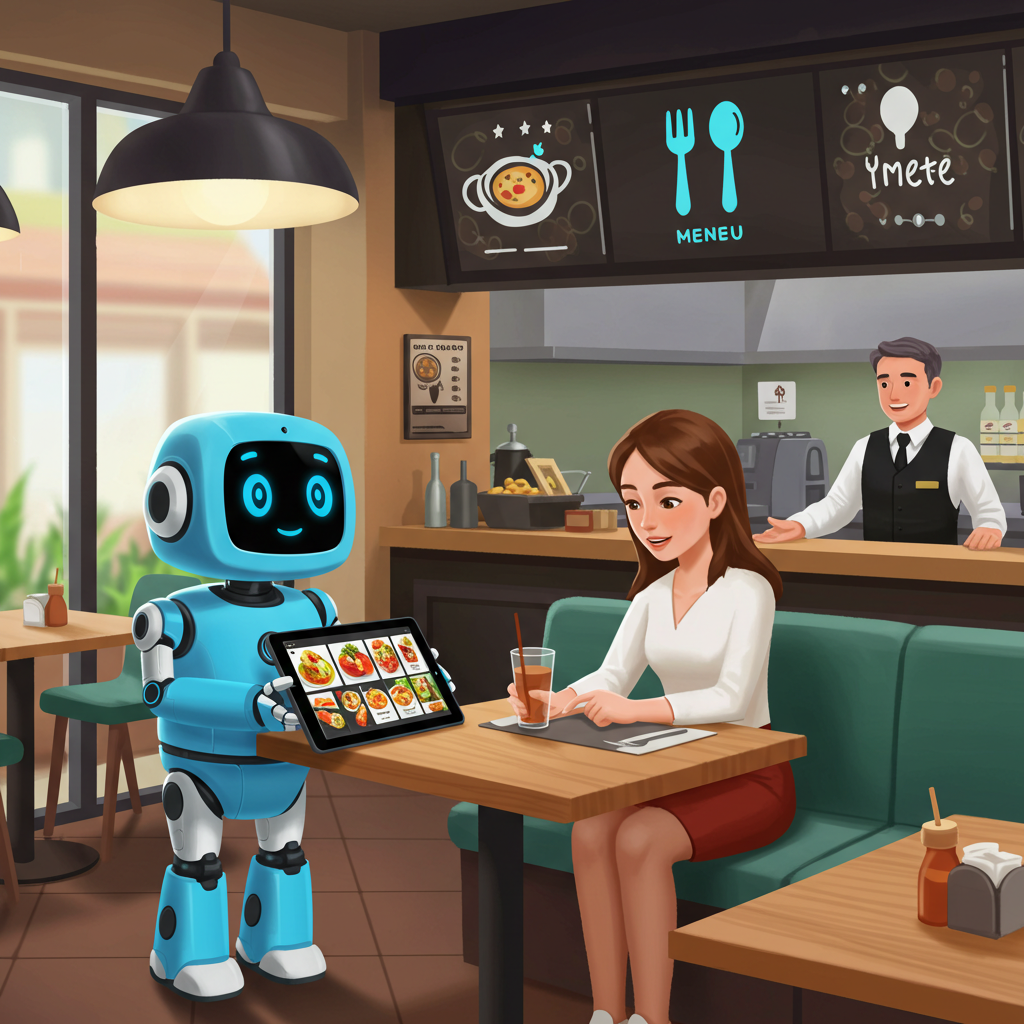
Imagine a restaurant where everything just… flows. Orders are taken perfectly, ingredients are always fresh and in stock, and every customer feels like their favorite dishes are magically suggested to them. This isn’t a dream from a futuristic movie; it’s becoming a reality thanks to AI POS integration.
This revolutionary concept is transforming how modern restaurants operate. It merges the incredible capabilities of Artificial Intelligence (AI) with traditional Point of Sale (POS) systems. Think of it as giving your cash register a super-smart brain!
This powerful combination is bringing unprecedented efficiency, deeper data-driven insight, and truly personalized customer experiences to the dining world (https://www.menusifu.com/bolg-en/restaurant-tech-trends-2025-ai-automation, https://www.abcpos.com/post/top-restaurant-technology-trends-how-pos-systems-are-evolving). For any business aiming to stand out, AI integration with restaurant POS is becoming incredibly important. Why? Because there’s a growing need to automate tasks, offer smooth and easy service, and make every single customer interaction count (https://loman.ai/blog/the-benefits-of-integrated-ai-systems-for-restaurant-pos, https://www.menusifu.com/bolg-en/restaurant-tech-trends-2025-ai-automation).
In this article, we’ll dive deep into what AI POS integration really means. We’ll uncover its many amazing benefits, explore practical ways you can enhance POS with AI, and see how it fits into the bigger picture of smart restaurant technology. Finally, we’ll gaze into the exciting future of restaurant POS AI and what it holds for the world of dining.
Key Takeaways
- AI POS integration is revolutionizing restaurant operations by merging AI capabilities with traditional Point of Sale systems.
- It brings enhanced efficiency, optimized inventory management, and truly personalized customer experiences.
- Key benefits include significant operational efficiency, reduced waste through predictive analytics, and data-driven decision-making.
- Practical integration methods range from Voice AI for order processing and intelligent upselling to automated customer feedback analysis.
- AI POS systems are foundational to the broader movement of smart restaurant technology, connecting various cutting-edge devices.
- The future promises hyper-personalization, deeper integration with robotics and IoT, predictive maintenance, and AI as a strategic business advisor.
Table of Contents
- What is AI POS Integration? Understanding the Core Concept
- Definition of AI POS Integration
- Moving Beyond Simple Transactions
- Unlocking Potential: The Multifaceted Benefits of an AI POS System
- Enhanced Operational Efficiency
- Optimized Inventory and Waste Management
- Personalized Customer Experiences
- Data-Driven Decision Making
- Improved Staff Productivity
- Strategies to Enhance Your POS with AI: Practical Integration Methods
- Voice AI for Order Processing
- AI-Powered Upselling and Cross-selling
- Predictive Analytics for Demand Forecasting
- Automated Customer Feedback Analysis
- Integration with CRM Systems
- AI POS Systems: Driving the Era of Smart Restaurant Technology
- Looking Ahead: The Future of Restaurant POS AI
- Hyper-personalization at Scale
- Deeper Integration with Robotics and Other IoT Devices
- Advanced Predictive Maintenance
- Seamless Omnichannel Experiences
- AI as a Strategic Advisor
- Conclusion: Embrace AI POS Integration for a Smarter, More Seamless Future
- FAQ
What is AI POS Integration? Understanding the Core Concept
Have you ever wondered what makes a restaurant truly “smart”? It starts with understanding AI POS integration. This isn’t just a fancy term; it’s a game-changer for how restaurants manage everything from taking orders to managing their ingredients.
Definition of AI POS Integration
At its heart, AI POS integration is about weaving Artificial Intelligence technologies directly into standard Point of Sale (POS) systems. These AI technologies include powerful tools like machine learning, which helps computers learn from data without being explicitly programmed; predictive analytics, which forecasts future events based on past data; and natural language processing, which allows computers to understand and process human language (https://www.abcpos.com/post/top-restaurant-technology-trends-how-pos-systems-are-evolving, https://www.menusifu.com/bolg-en/restaurant-tech-trends-2025-ai-automation).
Imagine your traditional cash register, which just records sales. Now, picture that same system being able to think, learn, and predict. That’s the power of an intelligent Point of Sale.
Moving Beyond Simple Transactions
So, how is this different from the old-fashioned POS? Traditional POS systems are mainly built to handle transactions. They process payments, print receipts, and track basic sales numbers. https://www.thebossman.ai/ai-voice-agents-restaurant-payments-future-dining They are essentially powerful calculators and record keepers.
However, AI POS solutions do much more. They take all that raw data—every order, every payment, every customer interaction—and turn it into something valuable. These intelligent systems process data, learn from patterns, and then use that knowledge to make smart recommendations or automate tasks that go far beyond just recording a sale. This fundamental shift makes the Point of Sale system a strategic tool for growing the business, rather than just a simple payment processor.
Instead of just knowing what was sold, an AI-powered POS can start to understand why it was sold, who bought it, and when they might buy it again. It transforms the humble cash register into a dynamic brain for your entire restaurant operation. This level of insight helps restaurants operate more efficiently, serve customers better, and make smarter business choices.
For a quick visual explanation of what an AI-powered POS system can do, check out this video:
Unlocking Potential: The Multifaceted Benefits of an AI POS System
The arrival of intelligent Point of Sale systems is a huge leap forward for the restaurant world. For restaurant owners, their hardworking staff, and, most importantly, their cherished customers, the benefits of an AI POS system are truly transformative. It’s clear that AI integration with restaurant POS is a game-changer, improving everything from the kitchen to the customer’s table.
Let’s explore some of these fantastic advantages in detail.
Enhanced Operational Efficiency
One of the most immediate and impactful advantages of an intelligent Point of Sale system is a significant boost in how smoothly a restaurant runs. AI automates many of the routine and repetitive tasks that used to take up staff time. Think about order entry, keeping track of inventory, or even answering basic customer questions. When AI handles these, service becomes much faster.
For instance, consider AI-powered self-service kiosks. Customers can place their orders directly and quickly, reducing queues and allowing staff to focus on more complex tasks or providing personalized assistance. Similarly, automated kitchen display systems (KDS) powered by AI can send orders directly to the right stations, prioritize cooking times, and ensure dishes are prepared in the correct sequence, leading to a much smoother kitchen workflow.
Furthermore, these AI-driven systems are incredibly good at reducing human errors. Misunderstandings in order taking, incorrect billing, or miscalculating discounts become much rarer. This increased accuracy means less waste, fewer complaints, and a happier team. The restaurant operates like a well-oiled machine, ensuring every part of the operation works together seamlessly.
Optimized Inventory and Waste Management
Food waste is a huge problem for many restaurants, leading to lost profits and environmental concerns. This is where AI POS integration shines brightly. https://thebossman.ai/ai-driven-restaurant-inventory-management-smarter-stock-solutions/ Predictive analytics, a key part of these intelligent systems, is like having a crystal ball for your kitchen.
This technology analyzes a huge amount of past data. It looks at historical sales records, understanding what sold well last Tuesday compared to last Friday. It considers seasonal trends, like how many hot chocolates are sold in winter versus iced teas in summer. It can even factor in local events, like a big concert nearby, which might cause a sudden surge in demand. By crunching all these numbers, the AI can forecast demand for specific ingredients with incredible accuracy.
This precise forecasting means you can order exactly what you need – not too much, not too little. This minimizes overstocking, which prevents ingredients from sitting around and spoiling. The result? Less food waste and significant cost savings. Imagine knowing precisely how many avocados or how much fresh fish you’ll need next week, almost down to the gram!
Beyond forecasting, AI-powered POS systems offer real-time stock tracking. Every time a dish is sold, the system automatically updates the inventory levels of its ingredients. If a certain ingredient is running low, or if a product is nearing its expiry date, the system immediately alerts management. This proactive approach helps prevent situations where you suddenly run out of a popular item or have to throw away expired goods, ensuring your kitchen is always stocked efficiently.
Personalized Customer Experiences
Today’s customers expect more than just good food; they want an experience that feels special and tailored to them. https://thebossman.ai/personalized-restaurant-ordering-ai AI POS integration makes this possible through hyper-personalization.
Imagine a system that remembers your favorite dish, your preferred drink, or even your allergies from your last visit. AI-driven recommendation engines can suggest menu items, additional side dishes (like “Would you like our special garlic bread with your pasta?”), or perfect drink pairings based on a customer’s past orders. It can also suggest items that are popular or trending right now. This makes ordering feel effortless and delightful, as if the restaurant truly knows you.
Furthermore, AI helps create super-smart loyalty programs. Instead of generic discounts, the AI analyzes a customer’s spending habits, favorite times to visit, and specific preferences to offer targeted rewards and promotions. If you love coffee, you might get a special offer on your next latte, rather than a discount on a burger you never order. This makes loyalty programs more engaging and valuable for customers, encouraging them to return again and again.
AI can even perform sentiment analysis. This means it can read and understand the “mood” of customer feedback. By processing comments from online reviews, social media posts, or direct surveys, the AI can quickly pick up on whether customers are happy, unhappy, or what specific issues they might have. This allows restaurants to quickly identify areas for improvement, address complaints promptly, and even reach out to customers proactively to make things right, ensuring everyone leaves with a smile.
Data-Driven Decision Making
In the past, restaurant owners often made decisions based on gut feelings or limited reports. With advanced AI POS systems, that’s no longer the case. These intelligent systems transform raw sales data into incredibly useful, actionable insights. It’s like having a team of expert analysts working for you 24/7.
What kind of insights can you gain? The AI can pinpoint your busiest hours and days, helping you schedule staff more effectively. It can highlight your best-selling menu items, showing you what dishes are truly making money and which ones might need tweaking or removal. It can even analyze employee performance metrics, identifying your top servers or areas where staff might need extra training.
Beyond day-to-day operations, the system can even suggest optimal pricing strategies. It can experiment with different prices for certain items and tell you which prices lead to the most sales and profits. All these insights empower restaurant management to make strategic decisions with confidence. Whether it’s planning staffing levels, redesigning the menu, or launching a new marketing campaign, every choice is backed by solid data, leading to better outcomes for the business.
Improved Staff Productivity
A busy restaurant floor can be chaotic, but AI integration with restaurant POS brings a sense of calm and efficiency, significantly improving staff productivity. By automating mundane and repetitive tasks, AI frees up your team members. Instead of spending precious minutes manually entering orders, updating inventory sheets, or calculating complicated bills, staff can dedicate their time to what truly matters: providing excellent customer service.
This means servers can spend more time interacting with guests, recommending dishes, and ensuring a pleasant dining experience. Kitchen staff can focus solely on preparing delicious food, knowing that orders are arriving correctly and ingredients are accounted for. The overall workflow becomes smoother, reducing stress for the employees and leading to a happier, more efficient team.
AI also assists with staff scheduling. https://www.thebossman.ai/ai-voice-agents-restaurant-scheduling By analyzing forecasted demand (which we discussed earlier), the AI can create optimized schedules that match the right number of staff to anticipated customer traffic. This reduces unnecessary labor costs during slow periods and ensures adequate staffing during peak hours, preventing burnout and improving service quality.
Finally, the intuitive interfaces of AI-powered POS systems can significantly reduce training time for new employees. Many tasks become simpler and more guided, allowing new hires to get up to speed much faster. This means less time spent on training and more time spent serving customers, benefiting both the new employee and the restaurant’s bottom line.
Strategies to Enhance Your POS with AI: Practical Integration Methods
Now that we understand the powerful advantages, let’s look at some practical ways restaurants can truly enhance POS with AI. These strategies show how intelligent Point of Sale technology can be put to work right now to improve operations and boost customer satisfaction.
Voice AI for Order Processing
Imagine walking into a bustling coffee shop and simply speaking your order, with a system instantly understanding it. https://www.thebossman.ai/ai-voice-ordering-restaurants-revolutionizing This is becoming a reality with voice AI. Implementing AI-powered voice assistants can revolutionize order taking, whether it’s in the fast-paced environment of a drive-thru, over the phone for takeout, or even at tableside within the dining room.
This technology relies on advanced Natural Language Processing (NLP). NLP allows the AI to accurately understand not just the words customers say, but also their meaning and intent, even if there are variations in accents or phrasing. This dramatically reduces errors often associated with manual order taking and significantly speeds up service times. For example, automated kiosks equipped with voice AI can handle routine orders, allowing human staff to focus on more complex requests or providing a personal touch, thereby freeing up valuable employee time and attention.
AI-Powered Upselling and Cross-selling
One of the cleverest ways to use AI in your Point of Sale system is for intelligent upselling and cross-selling. https://www.thebossman.ai/ai-voice-agents-restaurant-cross-selling Instead of staff trying to remember what to suggest, AI algorithms do the heavy lifting. These algorithms analyze a customer’s current order, along with their past purchasing behavior and even what other similar customers have bought.
Based on this analysis, the system can intelligently suggest relevant add-ons (like prompting “Would you like fries with that?” after a burger order), upgrades (e.g., “Upgrade to a large combo for just $2 more!”), or complementary pairings (such as “This delicious steak pairs perfectly with our robust Cabernet Sauvignon.”). The beauty of this is that it increases the average value of each transaction without being pushy or intrusive. It feels more like a helpful suggestion rather than a sales pitch, because the suggestions are genuinely relevant to the customer’s likely preferences. This intelligent prompting directly contributes to higher revenue and a more satisfying customer experience.
Predictive Analytics for Demand Forecasting
We touched on this earlier, but it’s worth detailing the practical application. Leveraging AI for predictive analytics is a cornerstone of modern restaurant management, especially when it comes to inventory and staffing. The AI doesn’t just look at yesterday’s sales; it dives into massive datasets. This includes:
- Historical Sales: What did you sell last year on this day?
- Weather Patterns: Does rain increase soup sales and decrease ice cream sales?
- Local Events: Is there a big game or concert nearby that will bring more people?
- Social Media Trends: Are people talking about a certain dish or ingredient that might suddenly become popular?
By analyzing all these factors, the AI can create highly accurate forecasts for customer traffic and the demand for specific menu items. This allows restaurants to prepare ingredients precisely, avoiding both shortages and waste. It also means staff levels can be optimized, ensuring enough hands are on deck during busy periods without overspending on labor during quieter times. This proactive approach minimizes stockouts, reduces spoilage, and ensures smooth operations, directly impacting profitability.
Automated Customer Feedback Analysis
Understanding what your customers think is crucial, but sifting through countless reviews and comments can be overwhelming. This is where AI truly helps enhance POS with AI. AI tools can quickly scan and analyze vast amounts of customer feedback. This includes online reviews from platforms like Yelp or Google, comments on social media, and even internal feedback forms or surveys.
The AI looks for specific keywords and analyzes the sentiment behind them. For example, it can quickly identify if multiple customers are complaining about slow service, cold food, or a particular menu item. This provides rapid insights into overall customer satisfaction, highlights recurring issues that need urgent attention, and points out areas where the restaurant is excelling. This capability enables management to respond quickly to problems, implement service recovery measures, and continuously improve the dining experience based on real-time customer voices.
Integration with CRM Systems
To truly maximize the power of AI POS integration, connecting it with Customer Relationship Management (CRM) systems is a smart move. A CRM system helps manage customer interactions and data throughout the customer lifecycle. When your intelligent Point of Sale system talks to your CRM, you create a unified, 360-degree view of each customer.
This integration means that every purchase, every preference, and every piece of feedback recorded by the POS is immediately updated in the CRM. This rich data allows for incredibly targeted marketing campaigns. You can send personalized offers based on a customer’s favorite meal, their birthday, or how long it’s been since their last visit. It also fuels robust loyalty programs, ensuring customers feel valued and receive rewards that are genuinely meaningful to them. This seamless connection strengthens customer relationships, encourages repeat business, and fosters a strong sense of community around your restaurant brand.
AI POS Systems: Driving the Era of Smart Restaurant Technology
We’ve talked a lot about individual benefits and practical applications, but it’s important to see how AI integration with restaurant POS fits into the bigger picture. It’s not just a standalone upgrade; it’s a foundational component of the exciting movement towards “smart restaurant technology.”
Think of a traditional restaurant as a collection of separate parts. The kitchen does its thing, the front of house handles orders, and the inventory manager counts stock. In a smart restaurant, however, all these parts are connected and communicate with each other, much like a single, intelligent organism. AI POS systems are the central brain in this interconnected ecosystem.
This advanced ecosystem encompasses various cutting-edge technologies working in harmony:
- Automation (Robotics): From robotic baristas to automated food prep assistants, AI-powered robotics are streamlining tasks and increasing speed. The POS system can send orders directly to these robots.
- Internet of Things (IoT) Devices: These are smart devices that can connect to the internet and share data. Imagine smart kitchen equipment that monitors cooking temperatures and alerts staff if something is off, or sensors in refrigerators that track ingredient levels and automatically reorder when supplies run low. These IoT devices feed valuable data back to the AI POS system.
- Data Intelligence: The AI POS processes all this incoming information, making sense of it and providing actionable insights.
All these elements are integrated, working together to create a seamlessly managed restaurant environment. This represents a transformative shift from old-school, manual, and often siloed processes to intelligent, automated, and interconnected restaurant operations. Every aspect of the business, from customer interaction to back-of-house management, is optimized.
This move towards “smart restaurant technology” isn’t just about cool gadgets; it’s about significant improvements where it counts. It dramatically improves overall efficiency, reduces the need for constant manual labor (thereby cutting labor costs), and, most importantly, provides a consistently superior and memorable customer experience. Guests get faster service, personalized recommendations, and a smooth dining journey, all thanks to the intelligent backbone provided by the AI-powered Point of Sale system.
Looking Ahead: The Future of Restaurant POS AI
The journey of AI POS integration is far from over; it’s just beginning. The “future of restaurant POS AI” promises even more sophisticated capabilities, transforming dining into an experience that is incredibly personalized, efficient, and almost magical. Let’s peek into the future to see what these intelligent systems will bring.
Hyper-personalization at Scale
Today’s AI can suggest dishes based on past orders. But tomorrow’s AI will go far beyond that. We anticipate AI evolving to proactively predict and cater to individual customer preferences, dietary needs, and even their mood, all without them having to explicitly tell the system. Imagine walking into your favorite cafe, and the system already knows your usual coffee order, suggests a new pastry based on your past likes, and maybe even knows you’re in a hurry and offers express checkout.
Systems could learn not just what you order, but how you order it, when you prefer to dine, and even your typical group size. This ultra-customized experience will make every visit feel uniquely tailored, fostering incredible customer loyalty and delight. The POS won’t just record transactions; it will anticipate desires.
Deeper Integration with Robotics and Other IoT Devices
The current level of AI POS integration with other technologies is impressive, but it will become even more profound. The AI-powered Point of Sale will truly become the central nervous system, orchestrating an entire symphony of smart devices.
We’ll see even closer connections with autonomous delivery robots, which the POS will direct to take food from the kitchen directly to customers’ tables or out for delivery. Smart kitchen appliances will become commonplace, from self-cleaning ovens that report their status to the POS, to ingredient dispensers that precisely measure and mix components based on orders received. Inventory sensors will communicate directly with the POS, not just tracking stock but predicting usage patterns and even initiating automatic reorders when supplies dwindle. This end-to-end automation will cover food preparation, delivery logistics, and stock management, all coordinated by the intelligent POS. This creates a seamlessly flowing operation with minimal human intervention for routine tasks.
Advanced Predictive Maintenance
Currently, AI often focuses on predicting customer demand and inventory needs. In the future, AI will extend its predictive powers to the physical infrastructure of the restaurant. Imagine an AI that can predict potential breakdowns in crucial kitchen equipment, like ovens, refrigerators, or dishwashers, before they even happen.
This will be achieved by analyzing usage patterns and data from embedded sensors within the equipment. The AI could detect subtle changes in performance, temperature fluctuations, or energy consumption that indicate a problem is brewing. Based on this, it can proactively schedule maintenance, alerting staff to potential issues and even ordering necessary parts. This capability will drastically reduce costly downtime, prevent service interruptions, and ensure that the kitchen always operates at peak efficiency, saving restaurants significant money and headaches.
Seamless Omnichannel Experiences
Today’s diners interact with restaurants in many ways: ordering online, dining in, using drive-thrus, mobile apps, and third-party delivery platforms. The “future of restaurant POS AI” will unify all these disparate customer touchpoints into one coherent, personalized experience.
Regardless of how a customer chooses to interact—whether they start an order on their phone, pick it up at the drive-thru, and then provide feedback via an email link—the AI POS systems will ensure all these interactions are connected and consistent. Their preferences, loyalty points, and order history will be accessible across all channels. This creates a frictionless and efficient experience for the customer, no matter which path they choose, and provides the restaurant with a complete picture of their customer’s journey.
AI as a Strategic Advisor
Finally, AI will evolve beyond just operational insights to become a true strategic advisor for restaurant owners. It won’t just tell you what happened or what to do next week; it will help you plan for the long-term future.
Envision AI providing sophisticated strategic advice based on deep market analysis, real-time competitor analysis, and identification of emerging food trends or new revenue streams. It could suggest menu innovations, evaluate the profitability of new locations, or even advise on marketing strategies to capture new demographics. The intelligent Point of Sale will become an invaluable business intelligence hub, empowering owners to make smarter, data-backed decisions that drive sustained growth and innovation in a competitive market.
Conclusion: Embrace AI POS Integration for a Smarter, More Seamless Future
We’ve explored the fascinating world of AI POS integration, from its core definition to its transformative impact on modern dining. https://www.thebossman.ai/ai-pos-integration-revolutionizing-restaurant-operations-for-modern-businesses It’s clear that merging Artificial Intelligence with your Point of Sale system isn’t just an upgrade; it’s a fundamental shift in how restaurants operate, bringing unprecedented efficiency, deeply personalized customer experiences, and powerful data-driven growth.
Strategic AI integration with restaurant POS is undeniably key to achieving operational excellence across the board. It empowers restaurants to streamline workflows, drastically improve staff productivity by automating tedious tasks, and deliver an unparalleled customer journey that keeps guests coming back for more. With every smart suggestion, every accurate forecast, and every personalized interaction, AI makes the restaurant experience smoother and more delightful for everyone involved.
For any business looking to thrive in an increasingly competitive landscape, embracing smart restaurant technology, especially through intelligent Point of Sale systems, is no longer optional. It’s how you revolutionize your business, prepare for the evolving demands of the future market, and create a truly intelligent dining experience that stands out.
Don’t wait for the future to arrive; build it today. Explore how AI POS integration can elevate your operations, delight your customers, and secure your restaurant’s place at the forefront of the culinary world. The dawn of intelligent dining is here, and with AI-powered POS, your restaurant can lead the way.
FAQ
Questions About AI POS Integration
Q: What is AI POS integration?
A: AI POS integration involves weaving Artificial Intelligence technologies like machine learning, predictive analytics, and natural language processing directly into traditional Point of Sale (POS) systems. This transforms a basic transaction processor into a smart system that can think, learn, and predict, going beyond simple sales recording to offer valuable insights and automation.
Q: How does AI POS integration enhance operational efficiency?
A: AI automates routine tasks like order entry and inventory tracking, speeds up service (e.g., through self-service kiosks and automated KDS), and significantly reduces human errors. This leads to smoother operations, less waste, and allows staff to focus on complex tasks and customer interaction.
Q: Can AI POS help with inventory management?
A: Yes, AI POS systems utilize predictive analytics to forecast demand for specific ingredients based on historical sales, seasonal trends, and local events. This minimizes overstocking and waste, ensures real-time stock tracking, and alerts management to low stock or nearing expiry dates, leading to optimized inventory and cost savings.
Q: How does AI enable personalized customer experiences?
A: AI-driven recommendation engines suggest menu items, add-ons, and drink pairings based on a customer’s past orders and preferences. It also powers smart loyalty programs with targeted rewards and performs sentiment analysis on feedback, making every interaction feel unique and valued.
Q: What are some practical ways to integrate AI with a POS system?
A: Practical methods include implementing Voice AI for order processing (e.g., drive-thrus, phone orders), using AI for intelligent upselling and cross-selling, leveraging predictive analytics for demand forecasting, automating customer feedback analysis, and integrating with CRM systems for a unified customer view.
Q: What does the future hold for AI POS in restaurants?
A: The future promises hyper-personalization at scale, deeper integration with robotics and IoT devices (for automated food prep, delivery, and stock management), advanced predictive maintenance for equipment, seamless omnichannel experiences, and AI evolving into a strategic advisor for long-term business planning and innovation.