
Estimated reading time: 10 minutes
Key Takeaways
- AI POS integration transforms restaurant operations by enhancing traditional Point of Sale systems with advanced intelligence.
- It addresses key industry challenges like rising labor costs and the demand for faster, more personalized customer experiences.
- Benefits include significantly improved operational efficiency, elevated customer satisfaction through personalization, optimized resource management, and substantial cost reductions.
- Practical applications today involve intelligent order taking (voice AI, self-service kiosks), tailored customer recommendations, and predictive inventory management.
- AI forms the backbone of comprehensive smart restaurant technology, ensuring seamless data flow across all customer touchpoints.
- The future of AI POS promises hyper-personalization, advanced robotics, multi-channel ordering, and ultra-sophisticated predictive analytics.
- Restaurants embracing AI are seeing an average of 15% more efficiency and a 10% jump in happy customer scores.
Table of Contents
- Understanding AI Point of Sale (POS) Integration
- The Unquestionable Benefits of an AI POS System
- How AI Can Enhance Your Point of Sale (POS) System Today
- AI as the Cornerstone of Smart Restaurant Technology
- Looking Ahead: The Future of Restaurant POS AI
- Conclusion
- FAQ
Understanding AI Point of Sale (POS) Integration
So, what exactly is AI POS integration? It’s basically when super-advanced computer intelligence, often called Artificial Intelligence (AI), is blended smoothly into the restaurant’s existing Point of Sale (POS) system. Think of it as giving your normal cash register and order-taking system a super-smart upgrade. This AI includes special computer brains like machine learning (ML), which lets computers learn from data, and natural language processing (NLP), which helps computers understand human language, plus predictive analytics, which is all about guessing what might happen next.
The main idea is to change old-fashioned POS platforms. Instead of just recording sales, these systems become intelligent “decision-making engines.” They constantly look at information, learn from it, and help automate complicated jobs. This means embedding smart AI programs that can do cool things like:
- Predicting what ingredients you’ll need: So you never run out of your most popular dishes.
- Automatically placing orders: For supplies when they get low.
- Spotting tricky things like fraud: Protecting your business.
- Understanding customer habits in real-time: Learning what people like to buy.
So, how does this smart system actually work? Traditional POS systems just write down what you sell. But AI-integrated systems are different. They actively “learn” from all the past information, like sales records and customer orders. They find patterns – like how Tuesdays are usually busy for pizza, or how sunny days mean more ice cream sales. Then, based on these patterns, they make smart suggestions and take action to make the restaurant run even better.
This technology cleverly mixes data analysis with special AI computer rules (algorithms) to make everything work smoothly across all the different ways customers can order. Whether it’s at the counter, through an app online, at the drive-thru, or over the phone, the AI makes sure every order is handled perfectly.
The best part? These smart AI systems connect easily with the restaurant’s current POS setup. They do all this without the tiny mistakes that can happen when people have to type everything in by hand. This means greater accuracy and less fuss, allowing restaurants to keep their existing equipment while getting all the benefits of new, smart technology. It’s like getting a brain upgrade without having to replace your whole body!
The Unquestionable Benefits of an AI POS System
When restaurants bring in an AI POS system, they unlock a treasure chest of amazing `benefits of AI POS system` adoption. These smart systems don’t just make small changes; they lead to big improvements in almost every part of how a restaurant works, from happy customers to saving money. Let’s dive into some of these great advantages.
A. Enhanced Operational Efficiency
One of the biggest advantages of an AI-powered Point of Sale system is that it makes operations much smoother and faster. These systems deliver significantly streamlined operations through many clever ways.
- Automated Inventory Management: Imagine never running out of ketchup or knowing exactly how many burger buns you’ll need next week. AI constantly watches your stock levels in real-time. It uses past sales data, like how much you sold last Tuesday, along with other clues like weather patterns (more hot chocolate when it’s cold!) and local events (a big concert means more pizza sales!). This helps it predict exactly what ingredients you’ll need. The system can even automatically reorder popular items when stock is low, stopping those annoying “out of stock” moments. This also cuts down on mistakes from manual counting, prevents food from going bad, and ensures everything stays fresh. That’s good for your food and your wallet!
- Optimized Staff Scheduling: Ever notice how some restaurants are super busy, but others feel empty? AI helps managers create the perfect work schedule for their teams. It looks at how busy the restaurant was in the past, when the busiest times usually are, and when employees are available to work. This makes sure there are enough people during rush hour, but not too many during quiet times. It’s a smart balance that keeps service great without wasting money on extra staff when they’re not needed.
- Faster and More Accurate Order Processing: Taking orders can be tricky, especially during a rush. AI-powered interfaces make it super easy. They use simple screens, can guess what menu items are being ordered as someone types them in, and automatically check if the order is correct. This means fewer mistakes (so no more wrong dishes!), less food waste, and customers getting their food much quicker. Everyone wins!
B. Improved Customer Experience
Happy customers are repeat customers, and AI integration really shines here. It dramatically makes customers happier in many ways. You’ll notice shorter wait times for tables, quicker service over the phone, more accurate orders, and even special meal suggestions just for you. The service quality becomes consistent and excellent every time.
- Personalized Recommendations: Have you ever wished your waiter knew exactly what you liked? AI-powered systems are like that! They keep track of what individual customers buy, their favorite foods, and past orders. Then, they use this information to suggest menu items tailored just for them. These smart suggestions might include the perfect wine to go with your meal, a dessert you’re sure to love, or other side dishes that fit your taste. This not only makes customers feel special and remembered, but it also often leads to them buying more, which is great for the restaurant!
- Accurate Order Taking: One of the most frustrating things is getting the wrong order. AI systems are brilliant at taking orders exactly right, even if the customer has a strong accent or speaks quickly. Research from McKinsey & Company shows that AI really improves customer experiences by offering personalized service, cutting down wait times, and making sure orders are spot on every time.
C. Optimized Resource Management
Managing a restaurant is all about using your resources smartly. AI helps with this in big ways.
- Predictive Inventory Management: This is like having a “crystal ball” for all your kitchen supplies and ingredients. Predictive inventory management is one of the smartest things AI can do for restaurants. The system very carefully looks at a lot of information: past sales, seasonal trends (like selling more hot drinks in winter), what’s happening in the local area (like a big festival), and even upcoming weather patterns. It uses all this to guess customer demand with incredible accuracy.
- Optimal Stock Levels: This intelligence helps restaurants keep just the right amount of food and drink in stock. It prevents the annoying problem of running out of popular items and also stops them from having too much of items that don’t sell quickly. The result is a big reduction in wasted food and things spoiling, which saves money and is great for being environmentally friendly.
- Staff Allocation: Imagine if your staff could spend more time greeting customers, answering questions, and making people feel welcome, instead of constantly picking up the phone or taking orders at the drive-thru. AI integration lets restaurants do just that! By handling tasks like phone orders, the AI frees up human employees to focus on helping customers who are actually in the restaurant. The National Restaurant Association agrees, highlighting how AI technology boosts efficiency by taking care of repetitive jobs, letting staff use their special human skills for great customer service.
D. Cost Reduction
Who doesn’t want to save money? AI technology helps restaurants cut down on costs in several key areas.
- Leaner Staffing: By letting AI handle things like phone orders and reservations, restaurants can run with fewer staff members. This doesn’t mean cutting jobs; it means empowering teams to work smarter, not harder. Employees can focus on more important tasks, making their work more meaningful.
- Focus on Experience: When the AI takes care of all the routine, repetitive tasks, restaurant staff have more time and energy. They can use this extra time to really focus on making each dining experience unforgettable. This special human touch is what makes customers want to come back again and again.
- Quick Return on Investment (ROI): Some might worry about the cost of getting new AI technology. But the good news is that this initial investment usually pays off pretty quickly. Most restaurants see noticeable improvements in how efficiently they run and how much profit they make within just a few months. It’s an investment that truly pays for itself!
How AI Can Enhance Your Point of Sale (POS) System Today
So, how can you actually `enhance POS with AI` right now and bring these fantastic advantages to life in a restaurant? Let’s look at some super practical and impactful ways Artificial Intelligence can boost your current Point of Sale system, making every aspect of the restaurant smarter and more efficient.
A. Intelligent Order Taking
Taking orders correctly is fundamental to a good restaurant experience. AI brings a new level of precision and ease to this process.
- Voice AI Integration: Imagine a world where phone calls and drive-thru orders are never mixed up. Voice AI uses something called Natural Language Processing (NLP) – which means computers can understand human speech – to completely change how phone ordering and drive-thru operations work. This smart AI system can accurately take customer orders over the phone, at the drive-thru window, and through other contactless ways. It does this perfectly every single time, no matter what accent someone has or how they speak. This makes ordering incredibly smooth and easy for customers. When it’s so simple and natural, people are much more likely to choose these channels for their future orders.
Here’s a great example of Voice AI in action for restaurant order taking:
- Self-Service Kiosks: You’ve probably seen these at fast-food restaurants. AI-powered self-service kiosks and voice recognition systems are brilliant because they get rid of the lines and waiting that often happen with old-fashioned order taking. They also dramatically cut down on mistakes that can lead to unhappy customers and wasted food. It’s like having an extra team of super-fast, super-accurate order takers that never get tired!
B. Personalized Customer Interactions
Making customers feel special is a surefire way to keep them coming back. AI excels at this by creating truly personalized dining experiences.
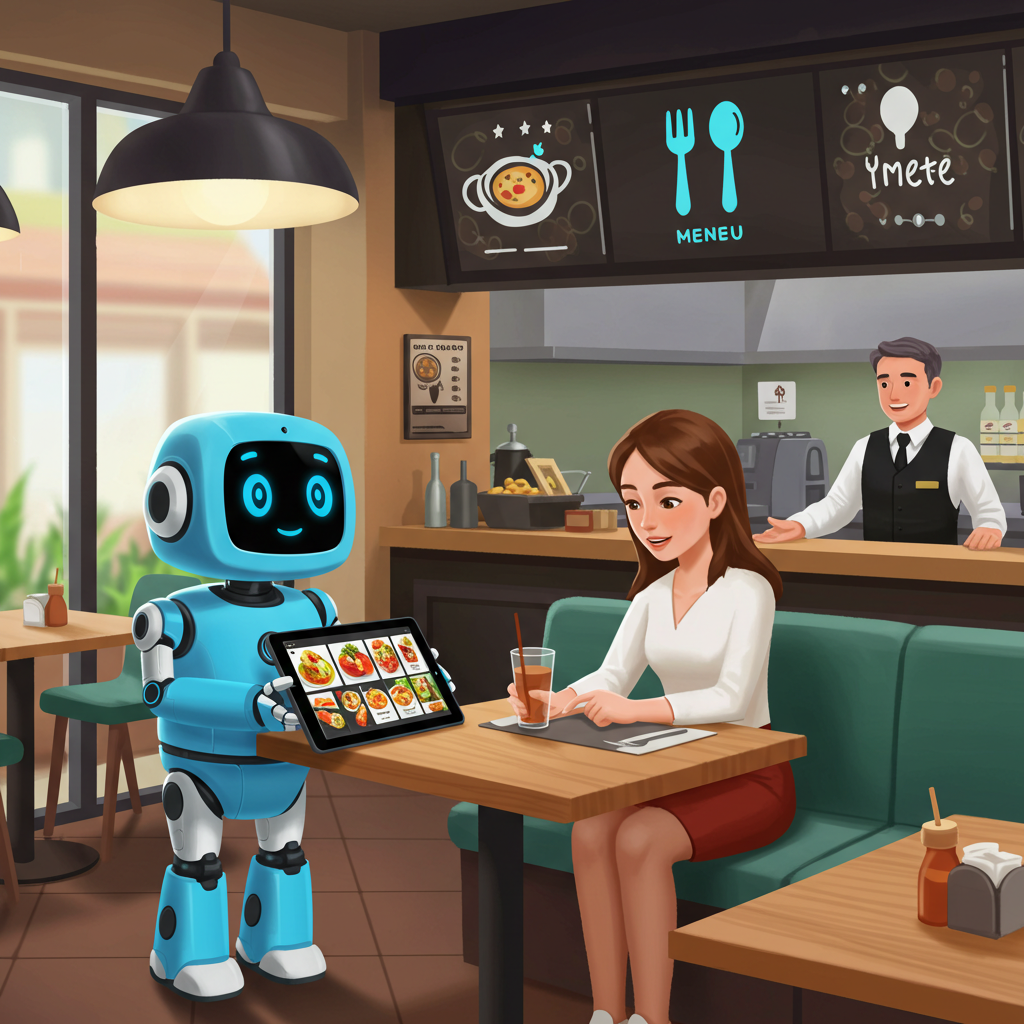
- Digital Waiter: Think of an AI-powered POS system as a “super attentive digital waiter.” This digital helper remembers and understands customer preferences better than any human staff member could possibly track manually, especially with hundreds of customers!
- Tailored Recommendations: This smart system constantly studies what each customer buys, their dietary choices (like if they prefer vegetarian meals), and all their past orders. With this detailed information, it creates special, personalized suggestions. These smart ideas for extra items or perfect meal pairings not only make customers feel truly valued and understood, but they also consistently lead to bigger orders and higher satisfaction levels. It’s like magic, but it’s just very clever AI!
C. Predictive Inventory & Supply Chain Management
Managing all the ingredients and supplies in a restaurant can be a huge headache. AI turns it into a breeze.
- Sophisticated Capability: Predictive inventory management is one of the smartest things AI can do for restaurants. The system very carefully looks at a lot of information: past sales, seasonal trends (like selling more hot drinks in winter), what’s happening in the local area (like a big festival), and even upcoming weather patterns. It uses all this to guess customer demand with incredible accuracy.
- Optimal Stock Levels: This intelligence helps restaurants keep just the right amount of food and drink in stock. It prevents the annoying problem of running out of popular items and also stops them from having too much of items that don’t sell quickly. The result is a big reduction in wasted food and things spoiling, which saves money and is great for being environmentally friendly.
D. Dynamic Pricing & Staff Augmentation
AI can even help with pricing and how your team works together.
- Dynamic Pricing Foundation: While the research didn’t go deep into this, the groundwork for dynamic pricing is built into AI’s ability to look at information in real-time and make automatic changes. Imagine prices for certain items shifting slightly based on how busy the restaurant is, what competitors are doing, or even the weather. The AI’s ability to process many different types of information all at once – like sales patterns, competitor prices, weather, and local events – creates the perfect system for making smart pricing decisions that maximize profits and reduce waste.
- Staff Augmentation: AI systems are like helpful co-workers for your staff. They assist with making sure orders are accurate, managing tables efficiently, and even helping with training new employees by giving real-time advice. This reduces the mental load on human workers, freeing them up to focus on those important face-to-face interactions that customers love. While AI handles the routine checks and process management, your human team can shine with great hospitality.
AI as the Cornerstone of Smart Restaurant Technology
Imagine a restaurant where every single piece of technology talks to each other perfectly, working as one big, smart brain. That’s exactly what AI-integrated POS systems create. They act as the central hub that smoothly connects all the different `smart restaurant technology` parts to build a complete, data-driven system that runs like clockwork.
The Artificial Intelligence itself becomes the operational brain of the entire restaurant. It brings together and coordinates many different systems. This includes:
- Kitchen Display Systems (KDS): These are the digital screens in the kitchen that show orders.
- Online Ordering Platforms: Websites or apps where customers place orders from home.
- Drive-Thru Interfaces: The systems at the drive-thru window.
- Phone Ordering Systems: Where phone orders are handled.
- Back-Office Management Tools: Systems for managing things like accounting, payroll, and employee records.
This clever, interconnected system allows restaurants to offer consistently high-quality service, no matter how a customer chooses to order. At the same time, it gathers a massive amount of valuable information. This data then helps the restaurant make even smarter decisions and keep improving how it works, creating an even better experience for everyone. It’s a truly smart way to run a business! For example, let’s say a customer places an order. It doesn’t matter if they order at the counter, over the phone, through an app online, or at the drive-thru. The AI system makes sure:
- The order is sent accurately to the kitchen.
- The correct ingredients are taken out of the inventory count.
- The customer’s profile is updated with their latest purchase.
- The payment is processed smoothly.
Looking Ahead: The Future of Restaurant POS AI
What does the future hold for restaurants with all this smart technology? The `future of restaurant POS AI` promises some truly exciting changes. We’re talking about super-personalized experiences, amazing robots helping out, ordering food seamlessly from anywhere, and unbelievably clever predictions about what’s needed.
Here are some key trends we can expect to see in the coming years with the `future of AI POS`:
- Hyper-personalization: This goes way beyond simply suggesting a dessert you might like. Imagine a dining experience that’s completely custom-made for you. The AI will know your favorite dishes, any foods you can’t eat, what you’ve ordered before, and even little things like the time of day or what the weather is like outside. It will use all this to create a dining experience that feels like it was designed just for you, every single time.
- Advanced Robotics & Automation: Get ready for robots! AI’s reach will extend beyond just the cash register (POS) and into the kitchen. We might see advanced robotic systems that can help with cooking, cleaning, or even serving, possibly leading to some parts of restaurants running almost entirely on their own for certain types of meals or services. This is not about replacing people, but about helping them.
- Seamless Multi-channel Ordering: Soon, ordering food will be incredibly easy and smooth. You could start an order on your phone, then decide to change it at a self-service kiosk, and finally pay for it at the drive-thru – all without losing any information or having to start over. It will be a totally frictionless experience, where your order follows you across different platforms with perfect accuracy.
- Ultra-sophisticated Predictive Analytics: The AI’s ability to predict things will become even more amazing. It won’t just guess what ingredients you need. It will be able to predict when kitchen equipment might need fixing before it breaks down. It could even predict big, long-term trends in the market or figure out the best way to optimize almost every tiny detail of how a restaurant runs. This will be based on spotting complex patterns in massive amounts of information.
However, with all these amazing changes come some new challenges. Things like keeping customer information private (data privacy concerns) and making sure staff know how to use all the new technologies (the need for staff training) are important things to think about.
The trick to success will be finding a good balance. We want all the benefits of automation, but we also need to keep that special human touch that makes going out to eat such a wonderful experience. Restaurants that can use the power of AI while still keeping their unique charm and friendly service will be the ones that truly succeed.
The speed at which these changes are happening is really fast. Experts believe that using AI will become a normal, expected part of the restaurant world within just five years. Restaurants that start using AI early will have a big advantage over their competitors. They’ll be more efficient, save more money, and make their customers much happier. Those that wait too long might find it hard to catch up, as customers will start to expect AI-powered conveniences as a basic part of good service.
Conclusion
It’s clear that AI POS integration is changing restaurants in a massive way. It’s not just a small improvement; it’s a powerful transformation. Restaurants that have already put these smart systems into place are seeing fantastic results: their operations are about 15% more efficient, and their customer satisfaction scores jump by an average of 10%. These are numbers that really make a difference!
Embracing this technology brings huge improvements to every part of running a restaurant. From making everyday tasks smoother and giving customers a much better experience, to making smarter decisions using data, saving lots of money, and helping employees be more productive – the `benefits of AI POS integration` are widespread and profound.
For any restaurant wanting to stay ahead, adopting AI POS integration isn’t just a good idea; it’s become absolutely essential. It’s crucial for staying competitive, growing steadily, and always meeting what modern diners expect. This smart technology tackles big problems that restaurants face today: high labor costs, the demand for special, personalized service, the tricky business of managing things across many different ordering methods, and the absolute need to make decisions based on real information in a fast-moving market.
So, the final thought is this: AI isn’t just a tiny upgrade for restaurants. It’s a must-have for building a business that’s ready for the future. A future-ready operation can easily adjust to new market conditions, changing customer tastes, and tough competition. The question is no longer “Should we put AI into our restaurant Point of Sale systems?” but rather, “How quickly can we use these technologies to secure our spot in a restaurant industry that’s being completely reshaped by intelligent automation?” The future of dining is here, and it’s powered by AI.
FAQ
Questions About AI POS Integration
Q: What is AI POS integration?
A: AI POS integration blends advanced Artificial Intelligence (AI), including machine learning and natural language processing, into a restaurant’s existing Point of Sale system. This transforms traditional POS into an intelligent control center for all operations, enabling predictive capabilities, automation, and personalized customer experiences.
Q: How does AI POS integration benefit restaurant operations?
A: It offers numerous benefits, including enhanced operational efficiency through automated inventory and optimized staff scheduling, improved customer experience with personalized recommendations and accurate order taking, better resource management through predictive analytics, and significant cost reductions by streamlining tasks and reducing waste.
Q: Can AI POS integration help with labor costs?
A: Yes, absolutely. By automating repetitive tasks like order taking (via voice AI or self-service kiosks) and inventory management, AI frees up human staff to focus on higher-value customer interactions. This can lead to leaner staffing models and more efficient use of human resources, ultimately reducing labor costs.
Q: Is AI POS integration difficult to implement?
A: Modern AI systems are designed to integrate smoothly with existing POS setups. While there’s an initial investment and a need for staff training, the return on investment is often quick, with many restaurants seeing improvements within months. The technology aims to enhance, not entirely replace, current infrastructure.
Q: What does the future hold for AI in restaurant POS?
A: The future points towards hyper-personalization, with dining experiences tailored to individual preferences. We can also expect advanced robotics in kitchens, seamless multi-channel ordering, and even more sophisticated predictive analytics for everything from equipment maintenance to market trends. AI is set to become a standard, expected feature in most restaurants within the next five years.